

Louis Arnolphe’s Masonic Webpage
A webpage on Freemasonry that tells you all about my Masonic writings and my ideas. | Page de présentation de mes publications maçonniques.
ABOUT THE AUTHOR / BIOGRAPHIE
Bro. Dr Louis Arnolphe is a French academic and Freemason. He was regularly initiated in Grande Loge Nationale Française (GLNF) about a decade ago, and later became a member of the high grades of the Rite Écossais Ancien et Accepté in the Suprême Conseil National de France (SCNDF). He holds an MSt and a DPhil (PhD) in History from the University of Oxford (Keble College) and lives in Paris, France.
Louis Arnolphe est universitaire et franc-maçon. Il fut initié il y a une dizaine d’années à la Grande Loge Nationale Française (GLNF) puis a rejoint les hauts-grades du Rite Écossais Ancien et Accepté au sein du Suprême Conseil National de France (SCNDF). Il est diplômé de l’Université d’Oxford, Angleterre (Doctorat en Histoire) et vit à Paris.
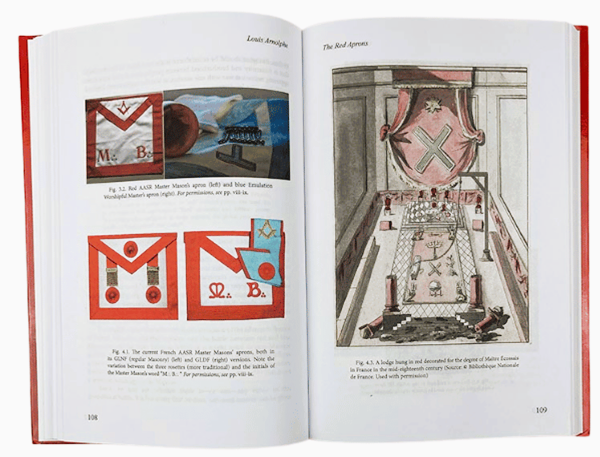
Illustrations taken from The Red Aprons (2026), pp. 108-109.
Chronological Masonic bibliography
Have a look at my most recent publications: They are described in details below. | Une liste de mes publications maçonniques en anglais et en français, détaillées ci-dessous.
ARTICLES
2027
‘Some Fascinating Aspects of Early Bordeaux Lodges (1750-1770)’,
Ars Quatuor Coronatorum 140 (2027) (Accepted for publication).
Summary: Coming soon!
2024
‘Why was “Freemason” Initially Translated as Franc-maçon in
France?’, Ars Quatuor Coronatorum 137 (2024), pp. 285-306.
Summary: This paper examines the controversial translation, that is still widely predominant these days in French-speaking countries, of freemason (in English) into franc-maçon (in French). Researching into this leads us to examine firstly the first occurrences of ‘frey-maçon, frimaçon and frée-maçon’ in France between 1737 and 1740, secondly the impact of the two Discourses by Andrew Ramsay in 1736 and 1737. Lastly, the word was used as meaning ‘Frankish’, and later plainly ‘French’, thus reappropriating a tradition that was foreign to the European Continent and turning it into something distinctly French with the use of the ‘Crusaders/Holy Land’ legend.
Note : Ars Quatuor Coronatorum (usually shortened as AQC) is the world-leading journal of Masonic history. It has been published in London since 1888. | Les ‘Ars Quatuor Coronatorum’ (généralement abrégés en AQC) sont publiés une fois par an. C’est une prestigieuse revue d’histoire maçonnique, publiée à Londres depuis 1888.
You may buy the article in PDF directly at / Commandez l’article en PDF à :
https://www.quatuorcoronati.com/research/research-resources/
BOOKS / LIVRES
#4 D’où venez-vous ? D’une Loge de Saint Jean | La Tarente : Aubagne (2026), 110 p. (Paru en août) NOUVEAU
Découvrir le livre en détail (19,00€) sur le site de l’éditeur


#3 The Red Aprons: The French Influence on Freemasonry
Macoy Publishing & Masonic Supply Company Inc. : Richmond,
VA (2026), 285 p. (published in March)
Watch a YouTube video (6:43)
Discover the book at Macoy US ($43.00)
NEW Now available in the UK through Lewis Masonic (£32.00)
#2 La Franc-maçonnerie et le mystère de l’Écossisme
MdV Éditeur :
Paris (2024), 120 p.
Découvrir le livre en détail (12,50€) sur le site de l’éditeur

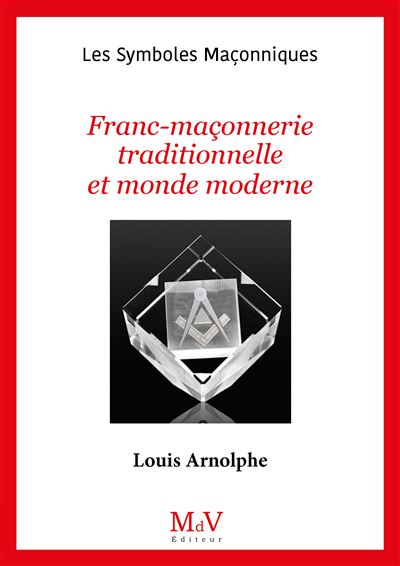
#1 Franc-maçonnerie traditionnelle et monde moderne
MdV Éditeur :
Paris (2024), 120 p.
Découvrir le livre en détail (10,90€) sur le site de l’éditeur
A SHORT INTRODUCTION TO MASONIC RESEARCH
What is Louis Arnolphe’s ‘New Masonic History’?
We need to go beyond the “authentic school’s” worn-out positivism
For the past hundred and forty years, we have been told that the “authentic school of Masonic history” (which was established in London around the Quatuor Coronati Lodge and the AQC journal in 1886—8) was the alpha and omega of Masonic research. This school of research was born out of the French philosopher Auguste Comte’s theory of positivism. Simply put, this theory held that a) only written proofs can be accepted as evidence in Masonic history, and b) that the existence of a phenomenon is only attested by the existence of a written proof and dated from then on.
For instance, since we do not have clear, written proof that the Master Mason degree was practiced in London until 1725, then 1725 is taken to be the year when this degree was “invented”. That was R.F. Gould’s claim (a famous English Masonic historian) in volume 1 of AQC (published in 1888), and nothing much has changed since then. Any doubt beyond this so-called “self-evident” principle is discarded by this school of researchers as “wishful thinking”, “romanticism” or even “blind unquestioning faith of little children” (G.W. Speth in 1888).
This is not only false, but also quite offensive when you come to think about it! Now, history has progressed through many different schools of thought and theories since the 1880s: Quantitative history, comparative history, global history, connected history, ‘histoire des mentalités’, cultural history, ‘Begriffsgeschichte’, oral history, micro history, ‘Alltagsgeschichte’, counterfactual history, and so forth. Yet, the “authentic school” has been in existence for almost 150 years, but its approach to Masonic history has not evolved. It is still stuck on problems that it considers unsolvable.
What is “the 3Cs paradigm”?
This is the reason why I decided to create a brand-new approach to Masonic history which I called “the 3Cs paradigm” or simply “New Masonic History”.
Why 3Cs? Because New Masonic History is:
- Complex: Freemasonry is “un fait social total” (a total social fact), a concept which the famous French anthropologist Marcel Mauss defined in his book Essai sur le Don (1925). Freemasonry is a cultural, economic, political, religious, social and symbolic phenomenon all at the same time. Masonic history thus requires extraordinary openness of mind to embrace the multifarious dimensions of the subject. It must be studied multidimensionally, using varied social sciences, and no longer in silos.
- Contextual: Masonic sources must be dealt with in the longue durée (long duration), as the famous French historian Fernand Braudel defined it. This means that they must be contextualised and interpreted in their long-run—that is, starting with a medieval backdrop—context and historical consequences. Freemasonry is not the sole product of English Enlightenment aristocrats looking for a convivial activity, it has a very long history and a deep spiritual meaning to its practitioners.
- Comparative: Masonic history requires comparison of sources between countries, languages, centuries, and rites in order to go “beyond parochialism.” Freemasonry is not the sole property of any one nation; it has become a fascinating world-wide phenomenon with multiple angles and documents which requires detailed analysis to avoid biases of interpretation. This can only come by resorting to foreign sources, rituals and languages.
The comprehensive analysis of comparative sources within their context and complexity thus yields brand-new results and conclusions. It was high time that something radically new was introduced in the research methodology—something that the American sociologist Thomas S. Kuhn called a paradigm—in order to save Masonic history from the embedded errors and anomalies of the past.
Conclusion: Living a happier spiritual life in Lodges is all that matters
And as I have already shown—in my book The Red Aprons: The French Influence on Freemasonry (2026) and two AQC articles (2024, 2027)—such a novel viewpoint on Masonic facts can bring about drastic changes in our understanding of the past, in order to live a happier spiritual life in our Lodges. Isn’t that all that matters in the end?
Ils en ont parlé…
What readers say
★★★★★
“Ce petit livre d’un jeune auteur capte immédiatement l’attention par sa clarté et la profondeur de sa pensée. Universitaire nourri d’une solide culture et d’une expérience maçonnique intensément vécue, il montre et démontre, ce que nous constatons tous, comment le monde moderne court à sa perte, alors que l’initiation à la maçonnerie traditionnelle peut nous redonner l’accès à la véritable connaissance.”
— Jacques Trescases, recension de Franc-maçonnerie traditionnelle et monde moderne, revue maçonnique suisse Alpina (Décembre 2022).
★★★★★
“Ce livre apporte une contribution fondamentale à la réflexion sur le travail maçonnique, son sens et sa finalité, tant individuelle que sociétale. Il apporte un message d’espoir qui s’adresse à tous ceux qui sont désireux de mieux percevoir le sens du monde qui nous entoure.”
— Jeanne Leroy, recension de Franc-maçonnerie traditionnelle et monde moderne, revue maçonnique Le Maillon (Juin 2022).
★★★★★
“Dr. Arnolphe’s study opens the world of French Freemasonry to American readers, who will find the French influence on English and American Freemasonry, as well as on Masonic terms, of great interest.”
— Dr. Mark Dreisonstok, PhD, Managing Editor of The Scottish Rite Journal about The Red Aprons (March 2026).
 Louis Arnolphe — Publications in Freemasonry and ‘New Masonic History’